
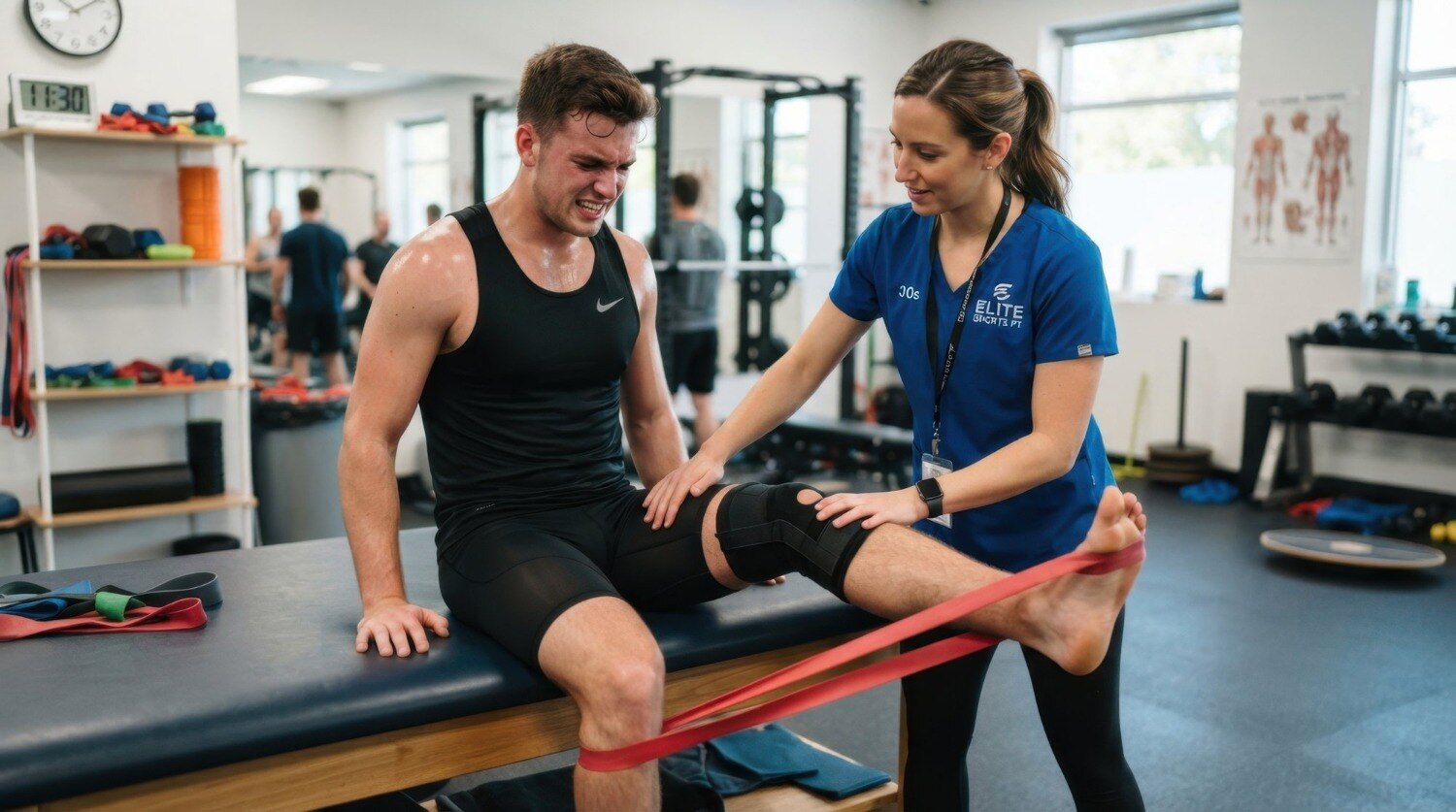
Mild stiffness after an unfamiliar or demanding workout is often delayed-onset muscle soreness, not an injury requiring treatment. The useful decision is whether your symptoms are steadily improving or interfering with movement, sleep, work or training. By the end, you will know when home recovery is reasonable, when assessment is worth the time and cost, and how to return to lifting safely.
Key takeaways
- DOMS is usually diffuse, peaks within 24–72 hours, and improves over several days.
- Seek assessment for sharp pain, swelling, weakness, bruising, or restricted movement.
- A physiotherapist checks movement, strength, technique, and symptoms before planning treatment.
- Return gradually with lighter loads and stop exercises that reproduce sharp pain.
Is it DOMS or a gym injury that needs assessment?
Ordinary delayed-onset muscle soreness (DOMS) is a diffuse ache and tenderness in the muscles you trained. It begins several hours after unfamiliar or unusually intense exercise, is usually worst during the next 24–72 hours, and improves within several days.
A physiotherapy clinic for post gym stiffness is not automatically necessary when symptoms steadily ease with walking, gentle movement, sleep and ordinary recovery.
| Pattern | More consistent with | What should prompt assessment |
|---|---|---|
| Diffuse ache in exercised muscles | DOMS | Symptoms peak by 24–72 hours and then improve |
| Sharp, focal pain, a pop, bruising or local swelling | Muscle strain or tendon problem | Pain persists, weakness appears, or the area cannot load normally |
| Pain over a joint, instability or inability to bear weight | Joint injury | Arrange prompt assessment, especially after a fall or twist |
| Numbness, tingling, burning or radiating pain | Nerve irritation | Seek assessment if sensation or strength changes |
Do not treat severe weakness, pain disproportionate to the workout, marked swelling, or dark tea- or cola-coloured urine as routine stiffness; these can signal rhabdomyolysis and require urgent medical evaluation. Prompt care is also needed after a pop with major bruising, visible deformity, inability to use the limb normally, or worsening symptoms.
A physiotherapist can examine movement, strength, joint function and neurological signs when the pattern is unclear.
When is post-workout stiffness worth paying to assess?
Steadily improving stiffness that eases with walking, gentle movement, sleep and ordinary recovery does not automatically justify post workout stiffness physiotherapy. Pay for an assessment when the problem affects what you can do, not simply because it has been painful for a certain number of days.
| Situation | Practical decision | Why it matters |
|---|---|---|
| Mild, diffuse stiffness that is improving | Keep moving gently, reduce aggravating loads and monitor it | Recovery is progressing without professional input |
| Stiffness limiting squatting, walking, reaching, work or sleep | Arrange an assessment | Restricted function suggests more than routine soreness |
| Movement has not started returning after several days | Arrange an assessment | Lack of improvement changes the decision |
| The same stiffness keeps recurring | Arrange an assessment | Repeated episodes may reflect load, technique, mobility or strength problems |
| You cannot train without altering or compensating for movement | Arrange an assessment | Compensation can shift stress to another tissue |
A persistent restriction matters more than the number of painful days alone. A sore back that still lets you walk, work and move progressively is less concerning than a two-day problem that prevents squatting or reaching. A physiotherapist can identify the limiting tissue and help you adjust load, range or exercise selection.
Do not repeatedly stretch into sharp pain or lift heavily to “test” the area. That can keep an irritated muscle, tendon or joint aggravated and prolong the problem. Stop the provoking movement, keep comfortable motion, and seek assessment if function is not returning.
What happens during a physiotherapy assessment and treatment plan?
A useful assessment begins with your training history, not a massage. The physiotherapist should ask which exercise, load, volume and technique triggered symptoms, when they started, and whether they are improving, spreading or becoming sharper.
The examination may compare active and passive range of motion, strength, joint stability and movement quality during a squat, hinge, lunge or relevant upper-body lift. It may also check altered sensation, radiating pain, reflexes or other neurological findings when symptoms suggest nerve involvement.
| Condition | Management focus | What progress should show |
|---|---|---|
| DOMS | Gentle movement, recovery and gradual return to training | Ache and movement improve over several days |
| Muscle strain | Reduce aggravating load and range, then rebuild strength progressively | Better force and pain-free movement |
| Tendon irritation | Adjust volume, frequency and exercise selection, then graded loading | Improved tolerance to repeated loading |
| Joint injury | Protect the joint while assessing stability, swelling and range | Safer movement without giving way |
| Disc-related pain | Modify positions and loading while monitoring leg symptoms and strength | Less radiating pain and improved function |
| Technique-related restriction | Change setup, exercise choice, range or tempo | Cleaner movement at a suitable load |
Treatment might include mobility work, progressive strengthening and a measurable home programme with targets such as range, repetitions or lifting tolerance. Manual therapy can provide short-term symptom or range changes, but repeated passive treatment alone does not correct load or technique problems.
Imaging is not automatically needed for uncomplicated soreness; examination usually guides the first plan.
How should you prepare and return to the gym?
Pause the lift that aggravates your symptoms before the appointment; do not keep testing it through sharp pain. Record the exercise, load, sets and technique that triggered the problem, then note when symptoms began, where you feel them and how long they last. Bring relevant scan reports, prescriptions and medical information.
1. Keep fitness with movements that remain pain-free. A physiotherapist may replace squats with cycling, heavy pressing with lighter supported work, or painful ranges with shorter ones instead of prescribing total rest.
2. Resume the target lift with less load, fewer sets or a smaller range of motion. Keep discomfort mild, controlled and settling during the session and afterward; stop if each workout leaves you worse.
3. Increase one variable at a time: load, volume, range of motion, frequency or intensity. Hold that change long enough to judge your response before adding another.
4. Stop training and seek reassessment if pain becomes sharp, symptoms spread, strength drops, swelling appears or the joint feels unstable.
The aim of physiotherapy for restricted movement after gym is measurable progress: better range of motion, strength, daily activity and tolerance of the target lift. Temporary looseness after one session is not proof that the problem has healed.
What makes a clinic worth the time and cost?
A worthwhile clinic earns its time and cost by giving you a working diagnosis, a measurable route back to training and clear reasons to change the plan.
| Option | What you should receive | What it means |
|---|---|---|
| Self-management | Recovery advice, gentle movement and gradual activity | Suitable for DOMS that steadily improves and does not restrict normal function |
| Active clinic plan | Explanation of the likely problem, movements to pause, home exercises and progress milestones | Useful when stiffness limits walking, squatting, reaching, work, sleep or lifting |
| Passive-only treatment | Repeated massage or manual treatment without loading guidance or reassessment | Poor value if you leave temporarily looser but still cannot train safely |
Ask how progress will be measured. A sound plan tracks range of motion, strength, daily activity and tolerance of the affected lift, then increases load, volume, range or intensity as those measures improve. Full training should have stated criteria, such as near-normal movement, restored strength, controlled technique and no symptom increase during or after loading.
Kaushik Physio Clinic is a local option to compare when stiffness limits function, keeps recurring or has not begun settling after several days. That does not make every ache a booking problem: ordinary DOMS that improves with walking, sleep, gentle movement and recovery is usually better managed without treatment.
Repeated stretching or lifting through sharp pain is different; it can prolong the problem and deserves assessment. A fixed number of visits is less useful than a plan that changes with your response.
Related service
Physiotherapy Post Gym Workout Stiffness Treatment ₹500 Stiffness and Pain Lack of Mobility Deadlift View service → |
Frequently asked questions
How can you tell DOMS from a gym injury?
DOMS causes diffuse muscle ache and tenderness after unfamiliar or intense exercise, peaks within 24–72 hours, and improves over several days. Sharp pain, swelling, bruising, sudden weakness, or restricted movement needs assessment.
When is post-workout stiffness worth paying to assess?
Book an assessment when stiffness limits daily movement, changes your technique, lasts beyond the expected DOMS period, keeps returning, or comes with sharp pain, weakness, swelling, or bruising.
What happens during a physiotherapy assessment for gym stiffness?
The physiotherapist reviews your training and symptoms, observes relevant movement, tests range of motion and strength, identifies contributing factors, and creates a treatment and exercise plan.
How should you return to the gym after stiffness or an injury?
Resume with easier variations, reduced load and volume, controlled technique, and adequate recovery. Progress only when movement is comfortable and symptoms do not worsen afterward.