
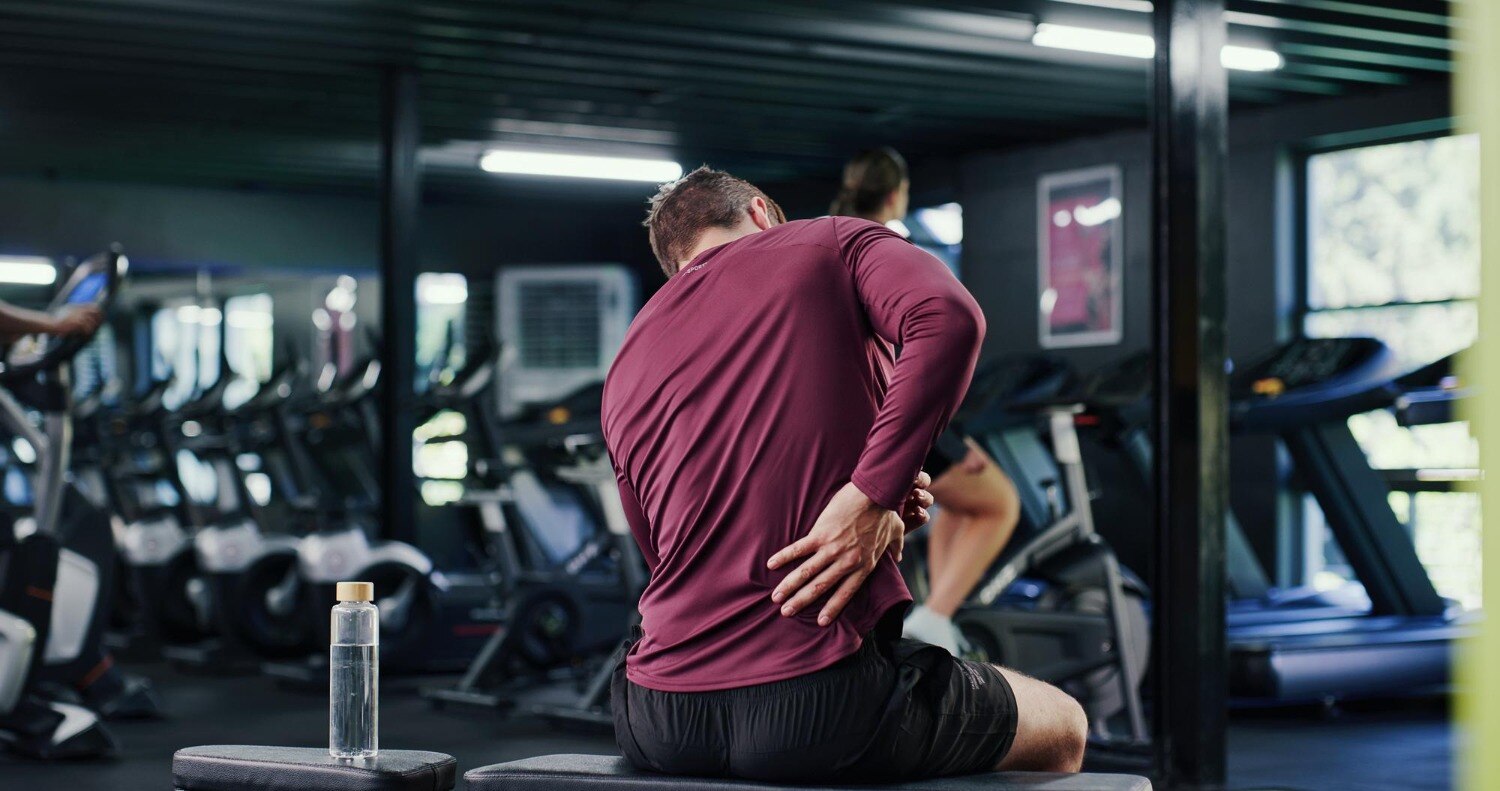
Stiffness that appears the day after a hard or unfamiliar workout is often delayed-onset muscle soreness, but worsening pain, nerve symptoms or unusual weakness requires a different response. You will learn how to judge the pattern, recognise urgent warning signs, understand a spine-focused assessment and return to training without repeating the injury.
Key takeaways
- DOMS starts 12–24 hours after exercise and peaks between 24 and 72 hours.
- Seek urgent assessment for weakness, numbness, loss of bladder control or severe pain.
- A spine-focused assessment checks movement, strength, reflexes and nerve symptoms.
- Resume heavy lifts gradually after pain-free movement and controlled practice repetitions.
Is Your Post-Gym Stiffness Normal Muscle Soreness or an Injury?
Pain that starts 12–24 hours after unfamiliar or high-load exercise, peaks between 24 and 72 hours, and improves over several days is usually delayed-onset muscle soreness (DOMS). It feels diffuse across the worked muscles, with tenderness and reduced movement, rather than one sharply localised spot or a neurological symptom.
| Pattern | More consistent with | What to do |
|---|---|---|
| DOMS | Aching, tender muscles after new or eccentric exercise; gradual improvement | Reduce load, keep gently moving, and monitor recovery |
| Back or joint injury | Focal low-back, hip or joint pain; pain worsens with a specific movement or load | Arrange assessment if it persists, limits function, or worsens |
| Tendon or ligament injury | Pain at a tendon or joint attachment, swelling, instability, or pain with resisted movement | Stop the provoking lift and seek physiotherapy assessment |
| Nerve irritation | Burning or electric pain, tingling, numbness, pain below the knee, or weakness | Obtain prompt medical review; worsening weakness needs urgent attention |
| Rhabdomyolysis | Severe muscle pain or weakness with marked swelling or tea-coloured urine | Seek urgent medical care for creatine-kinase testing and treatment |
A spine-focused assessment records the exercise, load increase, timing, pain distribution, sleep and functional limits, then checks lumbar and hip movement, strength, gait, sensation, reflexes and nerve tension when indicated. That finding-led approach is safer than labelling every symptom workout muscle stiffness treatment.
Seek urgent care after major trauma or for bladder or bowel loss, saddle numbness, fever, severe night pain, deformity or rapidly worsening weakness. Post gym stiffness physiotherapy is appropriate only after these warning signs are excluded.
Which Symptoms Need Urgent Medical Assessment?
Do not treat these warning signs as ordinary workout muscle stiffness treatment. Seek emergency medical care for symptoms that suggest neurological injury, severe muscle breakdown or spinal cord compression.
| Symptom | Why it matters | Action |
|---|---|---|
| New or rapidly worsening leg or arm weakness, foot drop, or trouble walking | Possible nerve-root or neurological compromise | Arrange urgent medical assessment today |
| Loss of bladder or bowel control, saddle-area numbness, or numbness spreading quickly | Possible cauda equina syndrome | Go to an emergency department immediately |
| Severe muscle pain or weakness with tea-coloured urine or marked swelling | Possible exertional rhabdomyolysis; creatine-kinase testing and medical management may be needed | Seek emergency care |
| A fall, collision, visible deformity, or sudden inability to bear weight | Possible fracture, dislocation or major ligament injury | Obtain urgent assessment and avoid loading the area |
Also seek prompt medical review for fever with back pain, unexplained weight loss, severe night pain, or pain that radiates below the knee with tingling or numbness. These findings require more than routine physiotherapy until a clinician checks strength, sensation, reflexes and other neurological signs.
Stop training while arranging care. Do not stretch forcefully, repeat the workout, or mask worsening symptoms with massage and pain medicine. A physiotherapist can help when symptoms are stable, but progressive weakness, neurological change or systemic illness requires medical evaluation first.
What Happens During a Spine-Focused Assessment?
The assessment starts by identifying what changed: the exercise, load or volume, symptom onset, pain location, and whether discomfort is improving. Stiffness beginning 12–24 hours after unfamiliar training and easing over several days fits delayed-onset muscle soreness more than a spine disorder.
A physiotherapist examines:
- Lumbar and hip movement, including which direction reproduces symptoms
- Local tenderness, muscle control, strength and functional movements such as walking, sitting and bending
- Gait and lifting-related movement when relevant
- Reflexes, sensation and nerve-tension signs when pain travels into the leg or you report tingling, numbness or weakness
For post gym workout stiffness treatment, a spine specialist in Faridabad should base the plan on these findings rather than the word stiffness alone. Kaushik Physio Clinic is one option to check if you want an assessment that connects rehabilitation findings with referral when symptoms fall outside routine musculoskeletal care.
Imaging is not automatically needed for ordinary post-exercise soreness or uncomplicated back pain. A clinician may request an X-ray after major trauma or when a fracture or structural problem is suspected; an MRI becomes more relevant with persistent radiating pain, neurological changes, suspected nerve-root compression or symptoms that fail to improve with appropriate care.
Rapidly worsening weakness, bladder or bowel changes, saddle numbness, fever, unexplained weight loss or severe night pain require medical assessment. Severe muscle pain or weakness with tea-coloured urine needs urgent care and creatine-kinase testing for possible rhabdomyolysis.
Search results for spine specialist near me can include a physiotherapist, orthopaedic spine surgeon or neurosurgeon, so verify registration and the clinician’s examination, rehabilitation and referral role before booking.
What Does Post-Gym Stiffness Physiotherapy Actually Involve?
It is a decision-based recovery plan, not a single pain-relief technique. Post gym stiffness physiotherapy starts by matching treatment to the exercise performed, the timing and distribution of symptoms, changes in training volume, sleep and daily limitations.
| Approach | What it does | What it misses |
|---|---|---|
| Exercise recovery physiotherapy | Maintains tolerable movement and rebuilds strength, endurance and coordination in stages | Requires load changes and active participation |
| Resting | Reduces immediate demand on sore tissues | Prolonged inactivity can reduce capacity and confidence |
| Stretching, heat or massage | May temporarily ease tightness and improve comfort | Relief does not prove tissue healing or readiness to train |
| Pain medicine | Dulls pain perception | Does not correct weakness, poor control or excessive training load |
| Repeating the same workout | Tests the painful movement under the same demand | Can worsen an irritated muscle, joint, tendon or nerve |
During exercise recovery physiotherapy, the clinician may test lumbar and hip movement, strength, gait and movement control. Reflexes, sensation and nerve-tension signs are checked when symptoms suggest nerve involvement. The plan may reduce weight, range or volume before rebuilding the provoking exercise.
That differs from treating discomfort as permission to train hard again. If strength or coordination remains impaired, repeat the workout later or at a lower demand. Severe muscle pain with marked weakness or tea-coloured urine needs urgent medical assessment for possible rhabdomyolysis, not routine post gym stiffness physiotherapy.
How Do You Return to Deadlifts, Squats and Presses Safely?
Earn the next increase with control, not with temporary symptom relief. Start when you can walk, hinge and brace without a worsening response, then use a load that allows clean repetitions with two or three repetitions still in reserve.
Rebuild the movement before the weight. For deadlifts, begin from blocks or an elevated bar if the floor position provokes symptoms. For squats, use a box or partial depth before returning to full depth. For presses, use a lighter implement or supported position if stabilisation remains poor.
Keep your trunk and joint alignment steady throughout each repetition.
Use this progression:
- Practise the unloaded pattern until movement is smooth and your symptoms do not increase later that day or the next morning.
- Add a limited range with light resistance, then increase range only when control remains consistent.
- Add repetitions before adding weight, and raise the load in small steps while keeping the same technique.
- Reintroduce normal volume last; avoid testing a previous maximum during the first sessions back.
Exercise recovery physiotherapy can match these stages to your lumbar and hip movement, strength, gait and neurological findings. A workout muscle stiffness treatment plan should not rely on heat or analgesia to disguise impaired coordination. Leg pain, tingling or weakness requires clinical review before heavy lifting; worsening weakness needs prompt medical assessment.
Frequently asked questions
How can you tell DOMS from a gym-related injury?
DOMS usually starts 12–24 hours after unfamiliar or high-load exercise, peaks between 24 and 72 hours, and causes diffuse muscle tenderness. A sharply localised pain or neurological symptom needs assessment.
Which post-gym stiffness symptoms need urgent medical assessment?
Seek urgent care for new or worsening weakness, numbness, pain spreading into an arm or leg, loss of bladder or bowel control, saddle numbness, or severe pain after trauma.
What happens during a spine-focused assessment?
The clinician reviews your exercise, load and symptom pattern, then checks spinal movement, strength, reflexes, sensation and movements that reproduce your symptoms.
What does post-gym stiffness physiotherapy involve?
Treatment can include guided movement, mobility and strengthening exercises, load modification, recovery advice and a gradual return-to-training plan matched to your symptoms.
How do you return safely to deadlifts, squats and presses?
Restore pain-free movement first, then practise controlled repetitions with lighter loads. Increase load gradually and stop if sharp pain, spreading symptoms or loss of strength appears.