

Pain during gripping, wrist movement or lifting does not automatically mean you have tennis elbow. You will learn how to recognise the condition, understand the assessment process, follow a safe loading plan and choose appropriate tennis elbow treatment in Faridabad.
Key takeaways
- Tennis elbow is reduced tendon load tolerance, not simply acute inflammation.
- Assessment checks pain location, grip, wrist movement, strength and possible neck or nerve involvement.
- Progress exercises gradually; reduce load when pain worsens during or after activity.
- Choose a clinic that measures function and adjusts treatment as your strength improves.
What tennis elbow is—and how to tell it apart from other elbow pain
Tennis elbow is usually lateral elbow tendinopathy: irritation and reduced load tolerance in the common wrist-extensor tendon near the lateral epicondyle, the bony point on the outer elbow. Repeated or sudden overload causes it; it is not simply acute inflammation, so “anti-inflammatory” treatment alone does not restore tendon capacity.
Typical signs include:
- Tenderness directly over or just beyond the lateral epicondyle.
- Pain when gripping, opening a jar, shaking hands, or carrying a bag.
- Pain during resisted wrist or finger extension.
- Reduced grip strength, especially when the elbow is straight.
- Pain when lifting with the palm facing down.
You do not need to play tennis. Tool use, racket sports, manual work, caregiving, computer tasks and household activities can repeatedly load the tendon. Elbow pain treatment must match the activity that triggered the overload.
Pain in another location or with different symptoms points elsewhere:
- Golfer’s elbow affects the common flexor tendon on the inner elbow.
- Neck-related nerve or radial-nerve problems can cause numbness, tingling or weakness.
- Arthritis more often causes stiffness and restricted movement.
- A ligament injury follows a specific twist and may cause instability.
- A fracture usually follows trauma and produces marked pain, swelling or loss of function.
Seek medical assessment for marked swelling, deformity, fever, unexplained weight loss, significant trauma, numbness or progressive weakness. Stop self-directed care until assessed.
What happens during a physiotherapy assessment?
A physiotherapist can usually identify lateral elbow tendinopathy from your history and physical examination, without an immediate scan. The assessment also checks whether your symptoms fit a neck, nerve, joint, ligament or bone problem.
1. You describe when the pain began, whether a sudden injury preceded it, and the work, sport, caregiving, computer or tool-use demands that load your arm. The physiotherapist asks which tasks aggravate it, whether pain wakes you at night, your previous injuries and medical conditions, and how it affects lifting, gripping, dressing or work.
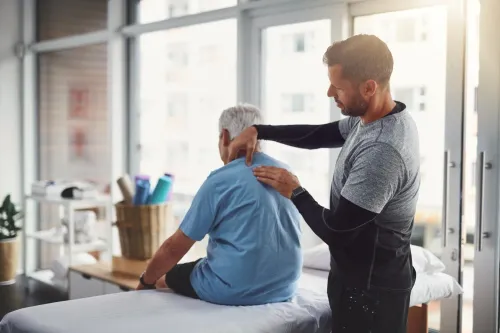
2. They observe your arm and compare movement, then palpate around the lateral epicondyle, elbow and forearm. They test elbow and wrist range of motion, resisted wrist and finger extension, and grip strength with the elbow bent and straight. They also screen your neck, shoulder and nerves for referred pain, numbness or weakness.
3. Imaging is not routinely required at the first assessment. An X-ray is useful when fracture, arthritis or another bone problem is suspected; ultrasound can examine tendon structure or guide a procedure. MRI is reserved for uncertain, atypical or persistent symptoms, or suspected deeper injury.
Seek medical review instead of self-directed tennis elbow physiotherapy after significant trauma or with marked swelling, deformity, fever, unexplained weight loss, numbness, progressive weakness, severe night pain or loss of movement.
Which treatments help, and which should not be used alone?
A practical plan combines relative rest, education and progressive loading rather than relying on a machine, injection or brace. For tennis elbow treatment in Faridabad, temporarily reduce heavy gripping, repetitive wrist extension and painful lifting, but keep tolerable elbow and wrist movement; complete immobilisation can reduce capacity.
- Modify tools, handles, lifting technique and work or sport volume so symptoms settle without stopping every activity.
- Use manual therapy when it improves movement or makes exercise easier.
- Try taping or a correctly fitted counterforce brace for short-term activity relief.
- Progress wrist-extensor and forearm strengthening, add stretching for mobility, and follow a graded return-to-work, sport or daily-activity plan.
Passive treatments can support rehabilitation, but they do not rebuild load tolerance alone.
| Treatment | Useful role | Important limitation |
|---|---|---|
| Corticosteroid injection | Short-term pain reduction | Commonly cited trials show poorer intermediate- and long-term outcomes and higher recurrence than observation or physiotherapy |
| Platelet-rich plasma and other injectables | Possible option after discussing uncertainty | Evidence is inconsistent because preparations, doses, comparison groups and diagnostic criteria differ |
| Manual therapy, taping or bracing | Temporary symptom or activity relief | They should not replace progressive strengthening; braces can cause discomfort or fail when poorly fitted |
Symptoms often improve gradually, sometimes over 6 months to 2 years. Surgery is usually considered only after substantial, well-delivered non-operative care fails and pain still limits function.
How to progress tennis elbow exercises without causing a flare-up
Increase the load only when the current exercise leaves your elbow at baseline by the following day. A staged tennis elbow physiotherapy plan builds tendon capacity without treating every discomfort as damage.
1. Begin with isometric wrist extension: press the back of your hand against your other hand or a fixed resistance without moving the wrist. Use a tolerable effort for several repetitions, with the physiotherapist choosing the resistance, repetitions and frequency according to your strength and irritability.
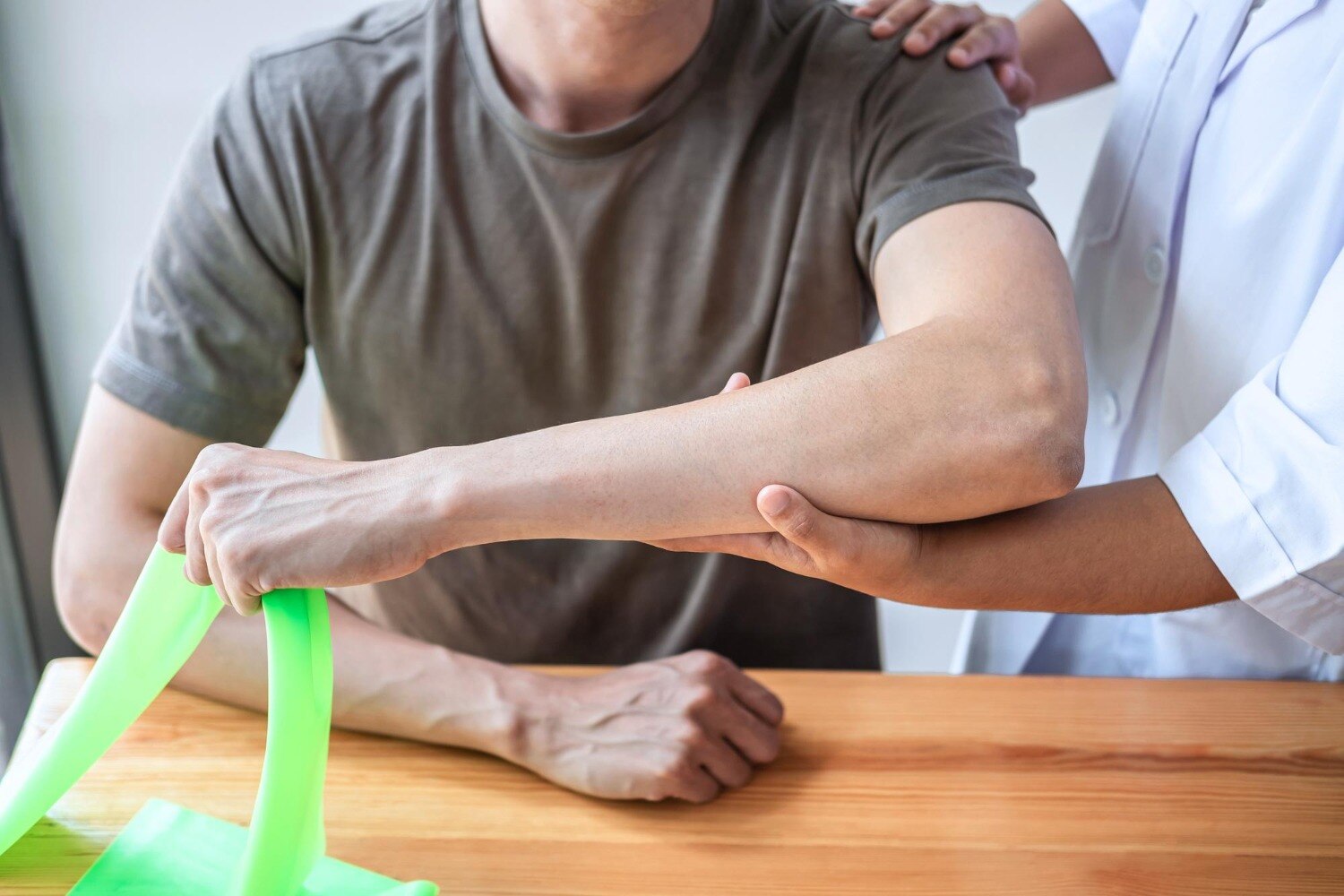
2. Progress to slow wrist-extension resistance using a light dumbbell or resistance band. Control both the lifting and lowering phases; eccentric work is not a reason to let the weight drop quickly.
3. Add grip strengthening with a soft ball, folded towel or adjustable grip device. Keep the effort controlled, then combine gripping with palm-down lifting and movements that resemble your work, sport or household tasks.
4. Increase resistance, repetitions or range one variable at a time when next-day pain, stiffness and function remain at baseline. If they are clearly worse, do not progress: reduce the repetitions, resistance or range and reassess.
Mild discomfort during exercise is acceptable when it settles after the session and returns to baseline the next day. Stop and seek review for sharp or escalating pain, numbness, weakness, swelling or loss of movement.
Gentle wrist and forearm stretching can maintain mobility, but it does not replace strengthening. Progression should follow your response, not a fixed timetable.
How to choose a Faridabad clinic and know whether treatment is working
A good search for “tennis elbow for physiotherapy clinic in faridabad” or “physiotherapy clinic near me” should lead to an assessment, not a preset machine package. The physiotherapist should record baseline pain, grip strength, painful movements, functional limits, and the work, sport, caregiving or household demands that aggravate symptoms.
Ask how the plan will cover relative rest, exercise progression, symptom rules, review timing and the next step if recovery stalls. The assessment should also screen your neck and nerves, and consider fracture, ligament injury and arthritis; numbness, progressive weakness, deformity, marked swelling, fever or significant trauma requires medical assessment rather than routine self-directed treatment.
| Clinic approach | What it tells you | Better choice |
|---|---|---|
| Fixed sessions and modalities | Treatment is counted by attendance | Choose a plan tied to measurable function |
| Exercises with no review date | Progression is unclear | Agree a review in about 2–4 weeks |
| Baseline testing and repeat measures | Change can be checked | Track pain, grip, movement and daily tasks |
Kaushik Physio Clinic in Faridabad is one local option for an individualised assessment and rehabilitation plan, but ask exactly how progress will be measured and when the plan will be reassessed.
Effective care is not defined by the number of sessions; it is defined by stronger grip, easier daily function and greater tolerance for the work or sport that caused the problem.
Related services
Orthopedics Physiotherapy ₹500 Outer Side of Elbow Pain Not Able To The Kitchen Work During Desktop Work Pain In Lifting objects View service → |
Orthopedic Physiotherapy ₹500 Joint Pain Stiffness Difficulty in Movements View service → |
Frequently asked questions
What is tennis elbow?
Tennis elbow is lateral elbow tendinopathy affecting the common wrist-extensor tendon near the outer elbow. Repeated or sudden overload can reduce the tendon’s ability to tolerate force.
What happens during a tennis elbow physiotherapy assessment?
A physiotherapist checks your pain location, elbow and wrist movement, grip strength, daily activities and loading history. They also screen for problems involving the neck, nerves or other elbow structures.
Which treatments help tennis elbow?
Treatment usually combines activity and load modification with progressive wrist and forearm strengthening. Hands-on treatment or symptom relief can support exercise, but anti-inflammatory treatment alone does not rebuild tendon capacity.
How should you progress tennis elbow exercises?
Start with a tolerable load and increase repetitions, resistance or activity gradually. Reduce the exercise dose when pain becomes sharper, affects movement or remains worse after the session.
How do you know whether tennis elbow treatment is working?
Track pain during gripping and lifting, morning stiffness, grip strength and the tasks you can complete. Improvement means better function and load tolerance, not only temporary pain relief.