


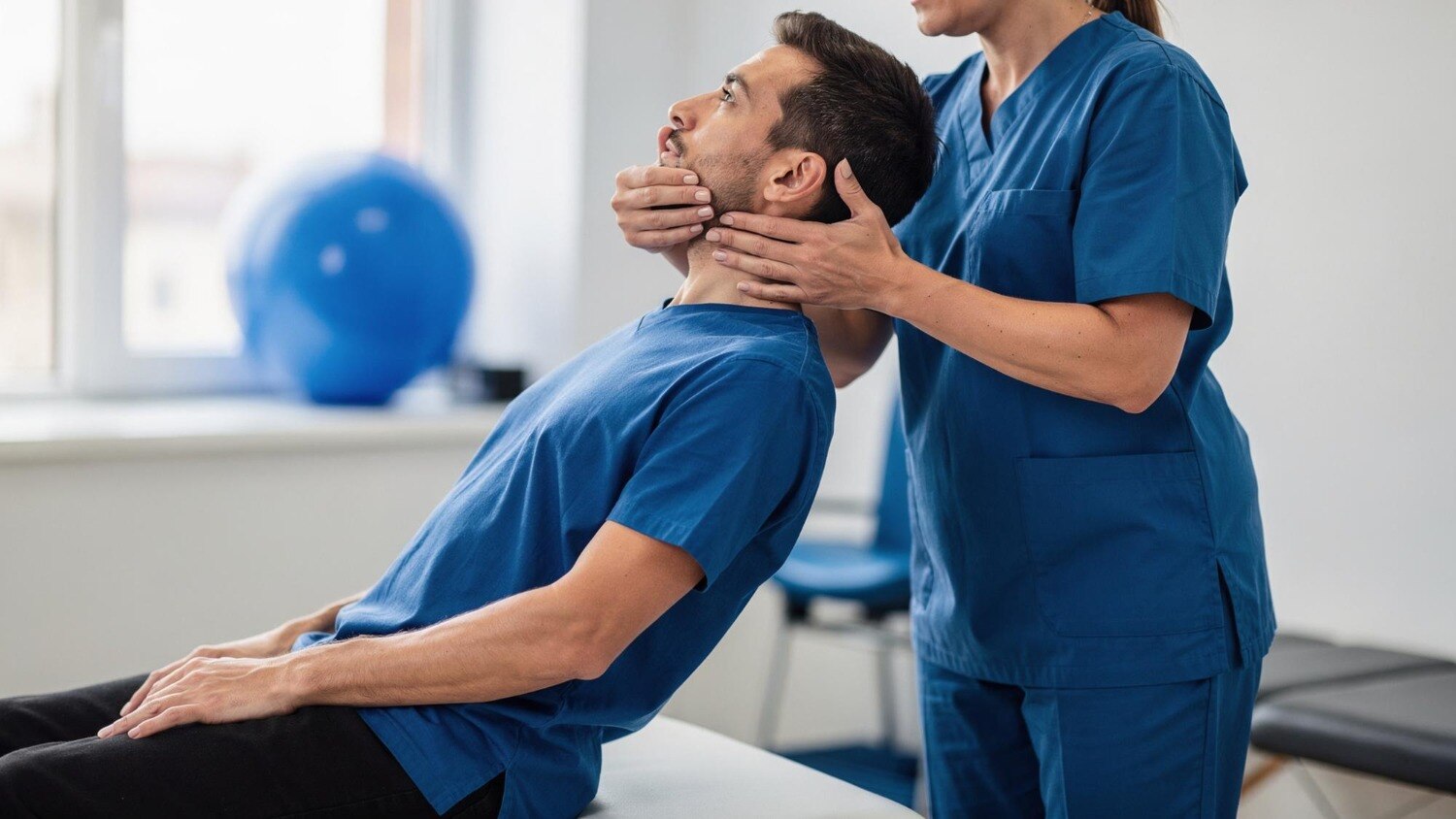
Cold, rain and pressure changes can coincide with a neck-pain flare, but research has not shown that weather consistently damages the cervical spine or directly causes pain. You can separate a true weather pattern from winter-related habits, manage a mild flare safely and recognise when an assessment is more appropriate than rest or home remedies.
Key takeaways
- Weather does not usually injure the cervical spine or create a new neck disorder.
- Track pain, sleep, activity and weather for two to four weeks before assuming a pattern.
- Use gentle movement, warmth and your prescribed exercises during a neck pain flare.
- Seek urgent help for weakness, severe headache, fever, trauma or loss of bladder control.
Does cold, rain or barometric pressure directly worsen neck pain?
Research has not established a consistent causal effect of temperature, humidity, rainfall or barometric pressure on neck pain. Reported associations are small and inconsistent, and changes in activity, sleep, mood and symptom reporting make them difficult to separate. A cold day does not normally injure the cervical spine or create a new structural disorder.
Cold exposure can encourage muscle guarding: your shoulders rise, muscles stay contracted and the neck moves less. That combination can intensify existing pain without proving that cold damaged the tissues.
| Explanation | What it means |
|---|---|
| Weather-triggered pain | Symptoms seem to follow weather changes, but the pattern needs repeated observation. |
| Muscle guarding | Cold increases tension and reduces movement, making the neck feel stiff. |
| Flare of an existing condition | Mechanical pain, cervical osteoarthritis symptoms or a whiplash-related problem become more noticeable. |
Pain that settles after gentle movement is not, by itself, evidence of arthritis. Degenerative changes on scans are common with age and do not always explain symptoms. The useful question is whether neck pain in winter repeats after you account for activity, posture, sleep and stress.
Record those factors alongside weather for several weeks; this gives a cervical pain physiotherapy assessment more useful evidence than relying on memory.
Why does neck pain in winter feel worse, and how can you test the pattern?
Winter often makes neck pain feel worse because your routine changes, not because cold has injured your cervical spine. You may sit indoors longer, drive differently, exercise less, sleep poorly, warm up inadequately or hold your shoulders tense against the cold. These changes can increase muscle guarding and stiffness.
A neck stiffness treatment plan works better when it targets the repeated exposure rather than blaming every flare on the forecast.
Track the pattern for three to six weeks. Record:
- Daily pain and stiffness scores from 0 to 10
- Outdoor temperature and rain
- Sleep duration, activity and warm-up
- Work or driving posture, stress and medication
- The time symptoms began, whether movement helped and whether changing position settled them
Compare similar activities on different weather days:
| Day pattern | Compare | What it may show |
|---|---|---|
| Cold and rainy | Sitting, driving, sleep and activity | Weather may coincide with the flare, but does not prove the cause |
| Dry and similar activity | Pain and stiffness scores | A stronger comparison than using unrelated days |
| Long sitting or reduced activity | Symptoms before and after movement breaks | Posture or inactivity may matter more than temperature |
Bring the diary to a clinician. A reproducible pattern is more useful than saying your neck hurts whenever weather changes. If symptoms mainly follow prolonged sitting or reduced activity, changing those exposures may help more than trying to predict barometric pressure.
What can you safely do during a weather-related neck flare?
Start with gentle movement, not bed rest or a rigid neck. Slow rotations, comfortable nodding and shoulder-blade movements for a few repetitions, repeated several times a day, can reduce guarding. Stop or reduce the range if arm pain, tingling or numbness appears.
- Keep work, driving and sitting positions within a tolerable range.
- Take brief movement breaks instead of holding one posture.
- Return to normal activity gradually rather than waiting for every symptom to disappear.
- Add gradual strengthening once basic movement feels comfortable.
- Reduce the exercise dose if pain remains substantially worse later that day or the next morning.
- Use a comfortably warm pack behind a cloth barrier for a limited session, then check your skin.
- Never sleep on a heating pad, apply heat to numb skin or use a scalding pack.
- Do not force a painful stretch, repeatedly pull your head to its end range, manipulate your own neck or use high-velocity movements.
Heat can ease the feeling of tightness, but it does not correct cervical alignment or replace active rehabilitation. Effective neck stiffness treatment focuses on movement, position changes and progressive capacity; cervical pain physiotherapy may add education, targeted exercises and strengthening when symptoms persist.
Passive heat or massage can feel relieving, but neither should become the whole plan. Adjust any exercise that repeatedly provokes symptoms rather than pushing through a flare.
What should a physiotherapy assessment check when weather seems to trigger pain?
A useful assessment checks the neck problem, not just the forecast. The clinician should distinguish nonspecific mechanical neck pain, cervical osteoarthritis, whiplash-related pain, headache associated with the neck and cervical radiculopathy.
- Ask when symptoms began, what movements or positions aggravate them, whether gentle activity helps, and how work, driving, sleep and stress affect the pattern.
- Examine neck range of motion, posture, shoulder movement and functional tasks rather than relying on a pain score alone.
- Check strength, sensation and reflexes when arm pain, tingling, numbness or weakness is present.
- Use relevant nerve-tension and movement tests to assess possible cervical nerve irritation.
- Identify warning signs such as progressive weakness, balance problems, difficulty walking, major trauma, severe headache with fever or neck rigidity, unexplained weight loss, or bladder and bowel changes.
For ordinary mechanical pain, effective cervical pain physiotherapy can combine education, continued activity, targeted range-of-motion exercises, strengthening and manual therapy when appropriate. Heat or massage may provide short-term comfort, but passive treatment should not replace exercise and self-management.
If you visit a physiotherapy clinic for weather related neck pain, ask what will be examined, how exercises will be progressed and how improvement will be measured.
A physiotherapy clinic in Faridabad such as Kaushik Physio Clinic should connect recurring symptoms with movement, work habits and functional goals instead of assuming every flare comes from temperature.
Related services
Orthopedic Physiotherapy ₹500 Neck Pain While Neck Movements Numbness And Tingling Sensation Difficulty During Neck Forward Bending View service → |
Physiotherapy Low back/ Neck Pain Post stroke physiotherapy Post fracture physiotherapy Frozen shoulder Knee pain/ Osteoarthritis Geriatric physiotherapy Pediatric... View service → |
When is home care enough, and when should you seek medical help?
Home care is reasonable for a mild, familiar flare that improves with gentle movement. Modify aggravating activities briefly, use a comfortably warm pack with a cloth barrier, and continue prescribed home exercises; adjust exercise if pain remains substantially worse later that day or the next morning.
Pain medicine can reduce symptoms, but follow its label or prescription and check its interactions and suitability with a pharmacist or clinician. Massage may feel relieving, yet its benefit is usually short term. Prolonged rest can increase stiffness, and a soft collar belongs to selected situations because routine prolonged use can reduce neck-muscle activity.
Consider physiotherapy when pain keeps recurring, disrupts sleep, limits work or daily activity, or fails to improve with sensible self-care. A physiotherapy clinic for weather related neck pain should assess your movement and neurological symptoms rather than assume rain or cold is the cause.
Effective neck stiffness treatment should not force painful movement or stretch into arm symptoms.
Seek urgent medical assessment for:
- New or progressive arm or hand weakness
- Loss of coordination or balance, or trouble walking
- Loss of bladder or bowel control
- Major trauma
- Unexplained weight loss
- Severe headache with fever and neck rigidity
Do not attribute these signs to weather or manage them with routine self-directed exercises. Choose care based on the symptom pattern and risk, not on whether the forecast predicts rain.
Frequently asked questions
Does cold, rain or barometric pressure directly worsen neck pain?
Research has not shown a consistent direct cause. Weather associations are small and inconsistent, while sleep, mood, activity and symptom reporting can change at the same time.
Why does neck pain feel worse in winter, and how can you test the pattern?
Cold weather often changes activity, sleep, muscle tension and time outdoors. Record pain, stiffness, sleep, activity, medication and weather conditions for two to four weeks to compare patterns.
What can you safely do during a weather-related neck flare?
Keep the neck gently moving, use comfortable warmth, adjust your posture and follow prescribed exercises. Stop exercises that cause spreading pain, numbness or weakness.
What should a physiotherapy assessment check when weather seems to trigger pain?
The assessment should examine neck movement, strength, sensation, reflexes, posture, shoulder function, work habits, sleep and symptoms that suggest nerve or spinal cord involvement.
When is home care enough, and when should you seek medical help?
Home care fits mild, improving stiffness without neurological symptoms. Seek urgent medical help after trauma or with new weakness, numbness, severe headache, fever, balance problems or bladder and bowel changes.
Related service
Orthopedics Physiotherapy ₹500 Lower Back Pain Neck And Shoulder Tension Leg Pain Postural Imbalance View service → |